
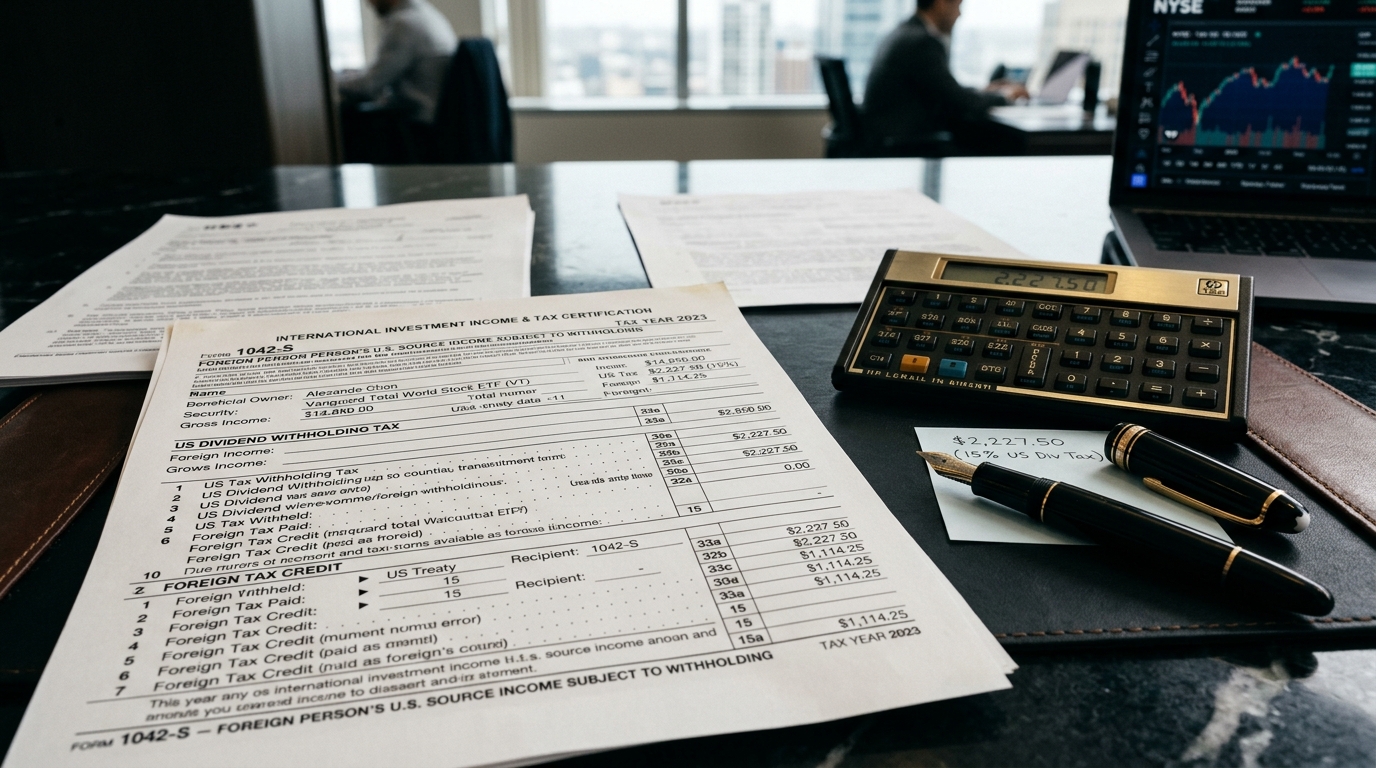
Every year, millions of self-directed Canadian investors build long-term wealth by purchasing the world’s most dominant corporate titans: Apple, Microsoft, Johnson & Johnson, and broad US index funds tracking the S&P 500. Yet when Canadian investors hold these equities inside their Tax-Free Savings Account (TFSA), a quiet, non-refundable 15% tax haircut is automatically extracted before the dividend ever touches their account ledger. Despite its name, the TFSA is not tax-free in the eyes of the United States Internal Revenue Service (IRS).
- The Treaty Blind Spot: The Canada-US Tax Treaty was ratified long before the creation of the TFSA in 2009. While Article XXI explicitly exempts pension plans (RRSPs, RRIFs), the TFSA is treated by the IRS as an ordinary foreign trust, subject to a mandatory 15% dividend withholding tax.
- The Unrecoverable Leakage: Because the TFSA emits no Canadian T3 or T5 tax slips, you cannot claim the IRS withholding tax as a Foreign Tax Credit. The 15% dividend deduction represents permanent, unrecoverable capital drag.
- The ETF “Wrapper” Trap: Holding a TSX-listed ETF that holds US stocks (such as Vanguard’s VFV or BMO’s ZSP) inside an RRSP still incurs the 15% withholding tax. The 0% treaty exemption applies only to US-domiciled ETFs traded in USD (such as VOO, VTI, or SPY).
- Cross-Referenced Asset Location: Deepen your tax efficiency with our masterclasses on Asset Allocation vs. Asset Location in Canada and our forensic audit of Canadian Robo-Advisors vs. Asset Allocation ETFs.
Why Does the IRS Tax US Dividends Inside a Canadian TFSA?
Under Article XXI of the Canada-US Tax Convention, mutual tax exemptions apply exclusively to trusts operated exclusively to administer retirement and pension benefits. Because the TFSA allows flexible, tax-free withdrawals at any age for any purpose, the IRS does not recognize it as a pension, subjecting all US dividends to the standard 15% withholding tax.
When you complete IRS Form W-8BEN through your Canadian discount brokerage (Questrade, Wealthsimple, TD Direct Investing, RBC Direct Investing), your US non-resident dividend withholding tax rate is reduced from the statutory foreign default of 30% down to the bilateral treaty rate of 15%. However, how that 15% is treated depends entirely on the Canadian account wrapper:
- Inside an RRSP or RRIF: Article XXI, Paragraph 2 of the Treaty explicitly waives the tax. If a US company pays a $100 dividend, your broker deposits exactly $100.00 USD into your RRSP account.
- Inside a Non-Registered Account: The IRS withholds $15.00, and you receive $85.00 USD. However, your broker reports the $15.00 on your Canadian T5 slip, and you claim a Foreign Tax Credit (Line 40500) on your Canadian tax return, completely neutralizing the US tax against your Canadian taxes payable.
- Inside a TFSA or FHSA: The IRS withholds $15.00, and you receive $85.00 USD. Because TFSA earnings are non-taxable in Canada, no Canadian tax slip is generated, and you cannot claim a Foreign Tax Credit. The $15.00 is permanently lost to the US Treasury.
The Asset Location Matrix: Where to Hold US Stocks in Canada (2026)
To eliminate US dividend drag, Canadian investors should hold US-listed dividend stocks and US-domiciled ETFs (e.g., VOO, VTI, SCHD) inside an RRSP or RRIF. Pure growth stocks paying zero dividends (e.g., Amazon, Berkshire Hathaway) or Canadian dividend equities should be prioritized inside the TFSA.
The following asset location matrix details the exact statutory withholding tax treatment across all major account types and investment structures in Canada:
| Asset & Currency Structure | Account Wrapper | US Withholding Tax Rate | CRA Foreign Tax Credit Eligible? | Net Annual Dividend Drag |
|---|---|---|---|---|
| US-Listed Stock / ETF (e.g., VOO, AAPL in USD) | RRSP / RRIF | 0% (Treaty Exempt) | No (Not Needed) | 0.00% (Maximum Efficiency) |
| US-Listed Stock / ETF (e.g., VOO, AAPL in USD) | TFSA / FHSA | 15% | No (Permanently Lost) | ~0.22% – 0.45% / year |
| Canadian-Listed US ETF (e.g., VFV, ZSP in CAD) | RRSP / RRIF | 15% (At Fund Level) | No (Cannot Recover) | ~0.22% – 0.25% / year |
| Canadian-Listed US ETF (e.g., VFV, ZSP in CAD) | TFSA / FHSA | 15% (At Fund Level) | No (Cannot Recover) | ~0.22% – 0.25% / year |
| US-Listed Stock / ETF (in USD) | Non-Registered (Taxable) | 15% | Yes (Claim Line 40500) | 0.00% (Fully Offset) |
Norbert’s Gambit: How to Buy US-Listed ETFs Without Currency Gouging
To purchase US-listed ETFs like VOO inside your RRSP without paying 1.5% to 2.0% bank foreign exchange fees, execute Norbert’s Gambit: purchase Horizon’s dual-listed fund (DLR.TO in CAD), journal the shares to the US dollar side (DLR.U.TO), and sell for USD cash at pure spot exchange rates.
Many investors avoid buying US-listed equities in their RRSPs because Canadian brokerages charge predatory retail foreign exchange markups (typically 1.5% to 2.0% above interbank spot rates) when converting CAD to USD. On a $100,000 portfolio conversion, standard bank FX gouging takes $1,500 to $2,000 right off the top.
By executing Norbert’s Gambit, you bypass retail spreads entirely, exchanging currencies for the cost of two standard stock trades (approximately $10 total). Once your RRSP holds clean US dollars, you can purchase US-listed index funds (like VOO with an ultra-low MER of 0.03%), capturing both the rock-bottom management fee and the 0% Treaty withholding tax exemption for life.
Asset location is the silent differentiator between average returns and generational wealth. While paying a 15% dividend withholding tax in a TFSA is not a financial catastrophe for an investor with a small $15,000 portfolio, for seven-figure wealth builders, unrecoverable foreign dividend drag compounds into tens of thousands of dollars in lost capital over two decades. Anchor your US-listed high-dividend equities and core S&P 500 allocations inside your RRSP where the Canada-US Tax Treaty shields every cent, and deploy your TFSA room into pure capital gains compounders.
People Also Ask
Should I avoid US stocks in my TFSA because of the 15% withholding tax?
No, you should not completely avoid US stocks in a TFSA. Capital gains in a TFSA remain 100% tax-free in both Canada and the US. If a US company pays little to no dividend (such as Berkshire Hathaway, Amazon, or Alphabet), the 15% dividend tax has virtually zero financial impact, while the massive capital growth remains completely shielded from Canadian taxation.
What is IRS Form W-8BEN and do Canadians need to file it?
Form W-8BEN is a Certificate of Foreign Status of Beneficial Owner for United States Tax Withholding. All major Canadian brokerages have clients electronically sign this form upon account opening. It certifies that you are a Canadian resident entitled to reduced bilateral tax treaty rates (15% instead of 30%).
Does the US withholding tax apply to capital gains on US stocks?
No. The IRS does not withhold any tax on capital gains realized by Canadian residents selling US stocks. Whether held in a TFSA, RRSP, or taxable account, capital gains are governed exclusively by Canadian domestic tax laws.
Are global all-in-one ETFs like VEQT or XEQT subject to US withholding tax?
Yes. Asset allocation ETFs listed on the TSX (such as VEQT, XEQT, or VGRO) hold US equities and international equities through underlying funds. They incur a drag of approximately 0.20% to 0.25% per year from unrecoverable foreign dividend withholding taxes across all account types, including RRSPs.
Related Investigations: Explore Tax-Loss Harvesting in Canada & The Superficial Loss Rule and our deep dive on US Citizens Living in Canada: TFSA and PFIC Traps.