
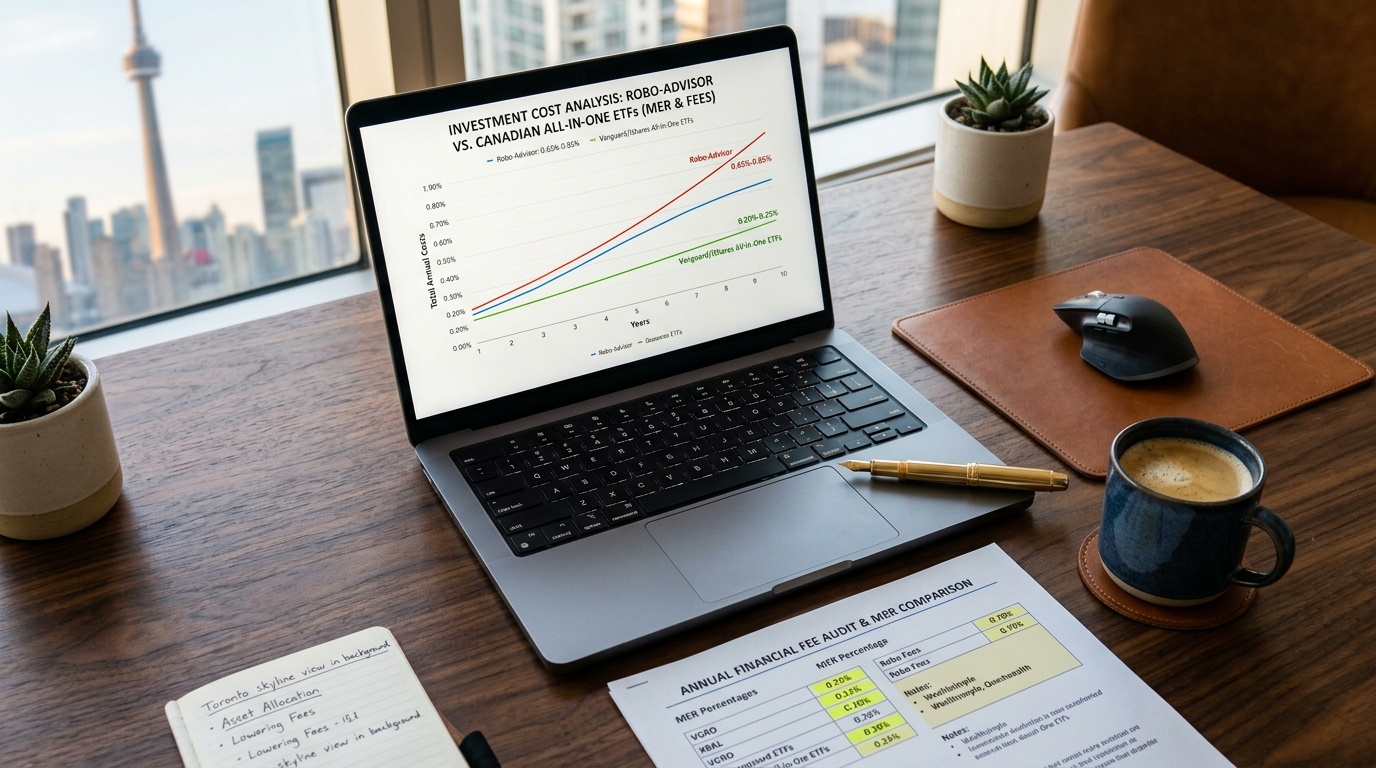
For Canadian investors deploying capital across TFSAs, FHSAs, and RRSPs in 2026, the choice between an automated robo-advisor (such as Wealthsimple Invest or Questwealth Portfolios) and an all-in-one asset allocation ETF (such as Vanguard’s VEQT/VGRO or iShares’ XEQT/XGRO) comes down to a single mathematical equation: is automated rebalancing and fractional share purchasing worth an ongoing 0.20% to 0.40% management fee drag? While robo-advisors charge between 0.40% and 0.50% on top of underlying ETF MERs (totaling ~0.60% to 0.75%), self-directed all-in-one ETFs cap total annual expenses at 0.20% to 0.24%. On a $300,000 portfolio over 25 years, that seemingly minor 0.45% annual spread siphons over $72,400 in lost compound investment growth directly out of your retirement nest egg.
- The Compounding Fee Gap: An investor holding $100,000 in Wealthsimple Standard pays ~$400/year in advisory fees plus ~$180 in underlying ETF MERs ($580/yr). The identical exposure held via VEQT or XEQT in a zero-commission brokerage account costs strictly $200/year, creating an annual $380 compounding headwind from Day 1.
- Built-In Internal Rebalancing: Asset allocation ETFs execute daily algorithmic cash-flow rebalancing inside the fund structure itself. When equity markets surge, fund managers rebalance internally without generating taxable capital gains distributions for unitholders.
- Tax-Loss Harvesting Reality: While robo-advisors promote automated tax-loss harvesting on taxable non-registered accounts, its actual alpha in Canada is heavily constrained by CRA’s strict 30-day Superficial Loss Rule and identical property provisions.
Forensic Fee & Feature Matrix: Canadian Platforms vs. All-in-One ETFs
Auditing the true all-in expense ratios across Canada’s premier passive investing mechanisms reveals where advisory friction erodes returns:
| Investment Vehicle | Advisory / Platform Fee | Underlying Product MER | Total All-In Drag | 25-Year Fee on $250k (6% Return) |
|---|---|---|---|---|
| All-in-One ETF (XEQT / VEQT) | 0.00% (DIY Brokerage) | 0.20% – 0.24% | 0.20% – 0.24% | $38,420 |
| Questwealth Portfolios | 0.20% – 0.25% | 0.17% – 0.22% | 0.37% – 0.47% | $71,150 |
| Wealthsimple Invest (Standard) | 0.50% (< $100k assets) | 0.18% – 0.22% | 0.68% – 0.72% | $106,890 |
| Wealthsimple Generation | 0.40% (> $500k assets) | 0.18% – 0.22% | 0.58% – 0.62% | $92,400 |
| Big 5 Bank Mutual Fund (Baseline) | Embedded Trailing Comm. | 1.95% – 2.35% | 2.15% (Typical) | $284,500 (Destructive) |
The 25-Year Compound Drag: Visualizing the Wealth Drain
While moving from a 2.2% bank mutual fund to a 0.68% robo-advisor is a massive leap forward in fee defense, stopping at a robo-advisor leaves tens of thousands of dollars on the table. To review how traditional retail banking fees dismantle compounding returns, inspect our foundational diagnostic on The 2.2% Bank MER Trap: How Canadian Mutual Funds Siphon 40% of Lifetime Wealth.
Consider two Canadian investors, each contributing $1,000 per month into their registered accounts (FHSA, TFSA, and RRSP waterfall) over a 25-year horizon, assuming a conservative 6.5% gross annualized market return:
- Investor A (All-in-One ETF @ 0.20% Net Return = 6.30%): Accumulates $728,450. Total lifetime fees paid to fund manager: approximately $21,200.
- Investor B (Robo-Advisor @ 0.68% Net Return = 5.82%): Accumulates $661,120. Total lifetime fees paid: approximately $68,800.
- The Net Opportunity Loss: Investor B sacrificed $67,330 in cold cash. That capital represents more than two full years of median Canadian retirement living expenses, forfeited simply to have software automatically purchase ETF units each month.
How Asset Allocation ETFs Eliminate Rebalancing Hassles
The primary value proposition advertised by robo-advisors is automated rebalancing: when equities rise and bonds fall, the software sells winners and buys losers to maintain your target risk profile. Five years ago, managing a 3-fund or 4-fund DIY couch potato portfolio (e.g., VCN, XAW, ZAG) required manual spreadsheets, trade ticket fees, and arithmetic calculations.
Asset allocation ETFs completely eliminated this operational burden. Funds like VEQT, XEQT, VGRO, and XGRO are single-ticker solutions containing thousands of underlying global equities and fixed income securities across Canada, the US, international developed, and emerging markets.
- Internal Cash-Flow Rebalancing: Fund managers rebalance the asset weights daily using new incoming investor cash flow, purchasing whichever asset class is underweight.
- Zero Transaction Fees: Modern zero-commission Canadian brokerages (National Bank Direct Brokerage, Disnat, Wealthsimple Trade, Questrade) allow you to buy and hold these ETFs for $0 in commission fees.
- Fractional Share Automation: Platforms like Wealthsimple Trade now allow recurring auto-deposits and automated fractional purchasing of XEQT and VEQT, completely replicating the robo-advisor’s “set-and-forget” automation for $0 in advisory fees.
The Tax-Loss Harvesting Fallacy in Canada
Robo-advisors frequently promote automated Tax-Loss Harvesting (TLH) as a key differentiator that allegedly “pays for the fee.” In Canada, this marketing claim collapses under forensic scrutiny. For a full breakdown of the tax code governing losses, read our investigation on Tax-Loss Harvesting in Canada: The 30-Day Superficial Loss Trap.
Unlike the US tax regime, the Canada Revenue Agency enforces strict Superficial Loss Rules:
# CRA Superficial Loss Mechanics (Income Tax Act s. 54)
If you sell Asset A at a capital loss, and you (or an affiliated person,
such as a spouse or corporate HoldCo) repurchase an "identical property"
within 30 days before or 30 days after the settlement date:
-> Capital Loss is DENIED (Added back to Adjusted Cost Base).
Because Canadian robo-advisors must swap between imperfectly correlated secondary ETFs (e.g., swapping Vanguard US Total Market for iShares Core S&P 500), tracking error frequently negates the minor tax benefit. Furthermore, tax-loss harvesting only applies to taxable non-registered accounts. If your capital resides inside a TFSA, RRSP, or FHSA, tax-loss harvesting is 100% irrelevant because capital losses cannot be claimed inside registered tax shelters.
To maximize your after-tax compound returns across registered accounts, pair single-ticker ETFs with our structural blueprint on Asset Allocation vs. Asset Location: How Account Structuring Saves $140,000+.
Behavioral Finance: When is a Robo-Advisor Justified?
Despite the mathematical fee drag, a robo-advisor remains clinically superior to human emotional failure. If managing your own brokerage account tempts you to panic-sell during market corrections, chase meme stocks, or let cash sit uninvested in your account for six months, a robo-advisor acts as a psychological guardrail.
Paying 0.50% to prevent behavioral self-sabotage is a rational bargain compared to sitting on the sidelines or panic-selling at the bottom of a bear market. However, if you possess the basic discipline to set up a recurring automated buy order for XEQT or VEQT once per month and ignore financial media noise, paying a robo-advisor is an unnecessary tax on your future wealth.
Alistair Vance’s Verdict
Robo-advisors served an essential transitional role in Canadian finance, breaking the monopolistic grip of the Big 5 banks’ 2.2% mutual funds. But in 2026, the financial ecosystem has evolved. With zero-commission trading and automated recurring fractional ETF purchases readily accessible, paying a 0.40%–0.50% advisory fee for a static portfolio is an archaic expense.
Pick an all-in-one ETF calibrated to your true risk tolerance—VEQT/XEQT (100% Equity) for long-term growth, or VGRO/XGRO (80/20) for balanced volatility—set up an automated monthly recurring deposit in a zero-commission account, and reclaim the $70,000+ in compound growth that belongs in your family’s estate.
Where to Expand Your Forensic Wealth Strategy Next
Continue fortifying your investment architecture, tax shelters, and estate defense with our forensic masterclasses:
- The 2.2% Mutual Fund Fee Audit: Measure the exact lifetime destruction of retail banking fees in our Bank MER Drag Calculator & Analysis.
- Cross-Border Account Traps: If you hold US citizenship, avoid devastating IRS penalties on TFSAs in our US Citizens in Canada TFSA & PFIC Guide.
- Optimizing Account Waterfalls: Maximize government grants and tax deductions in our FHSA vs. RRSP Waterfall Strategy.
People Also Ask
Are all-in-one ETFs cheaper than robo-advisors in Canada?
Yes, significantly. Asset allocation ETFs like VEQT, XEQT, VGRO, and XGRO have all-in management expense ratios (MERs) of roughly 0.20% to 0.24%. In contrast, robo-advisors charge an advisory management fee (typically 0.40% to 0.50%) on top of the underlying ETF fees, resulting in total annual costs of 0.60% to 0.75%—nearly triple the cost of holding the ETF directly.
Do asset allocation ETFs rebalance automatically?
Yes. Vanguard and iShares asset allocation ETFs rebalance automatically within the fund structure on a daily basis. The fund managers use continuous incoming investor cash flows and dividend distributions to purchase underweight asset classes, maintaining target equity-to-bond ratios without generating taxable capital gains for unitholders.
Can I automate buying VEQT or XEQT in Canada for free?
Yes. Modern Canadian discount brokerages such as Wealthsimple Trade and Qtrade allow investors to set up automated recurring bank deposits and recurring purchases of fractional ETF units for $0 in commission fees, delivering the exact hands-off automation of a robo-advisor without the 0.50% annual fee drag.
Is Wealthsimple Invest safe for large Canadian portfolios?
Yes, Wealthsimple is a regulated member of the Canadian Investment Regulatory Organization (CIRO) and the Canadian Investor Protection Fund (CIPF), which protects eligible accounts up to $1,000,000 against custodial insolvency. However, on portfolios exceeding $250,000, paying Wealthsimple’s 0.40% to 0.50% advisory fee creates substantial compounding drag compared to holding all-in-one ETFs directly.