
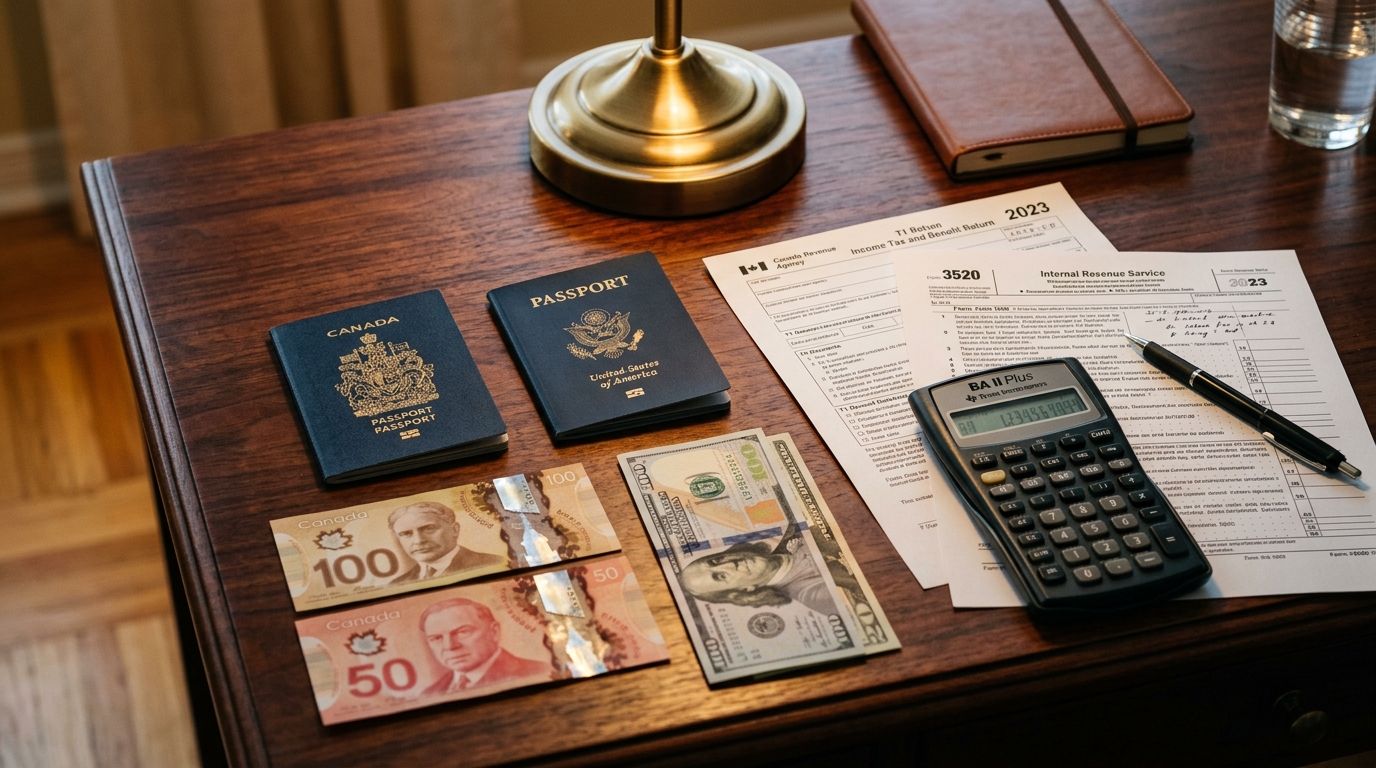
More than one million American citizens, green card holders, and dual citizens currently reside in Canada. While Canada’s financial ecosystem offers celebrated wealth-building vehicles—specifically the Tax-Free Savings Account (TFSA), First Home Savings Account (FHSA), and low-cost Toronto Stock Exchange index ETFs—for Americans, standard Canadian financial advice is a catastrophic regulatory trap. Under the Internal Revenue Service’s citizenship-based taxation regime, holding everyday Canadian investment products can trigger $10,000 IRS Form 3520 penalties, punitive PFIC excess distribution tax rates exceeding 50%, and crushing cross-border compliance audits.
- The TFSA Non-Recognition Trap: The US-Canada Tax Treaty does not recognize the TFSA as a tax-exempt account. All interest, dividends, and realized capital gains inside a TFSA must be reported as taxable income on IRS Form 1040, eliminating all tax advantages.
- Form 3520 / 3520-A Trust Penalties: If the IRS classifies your TFSA or RESP as a foreign grantor trust, failing to file Form 3520 and 3520-A carries an automatic statutory penalty of $10,000 or 35% of the gross trust value per violation.
- The Canadian ETF / PFIC Minefield: Canadian-domiciled ETFs (like XEQT, VEQT, or VCN) and mutual funds are classified as Passive Foreign Investment Companies (PFICs) under IRC Section 1291. Taxed under the default excess distribution regime, returns are stripped of capital gains treatment and subject to compounding back-interest penalties.
- The Safe Harbour Vehicles: RRSPs and RRIFs enjoy full treaty protection under Article XVIII. Outside registered pensions, US citizens must invest in US-domiciled ETFs (e.g., VTI, VXUS) or hold individual Canadian operating equities.
The Extraterritorial Grip of IRS Citizenship-Based Taxation
Unlike Canada, which taxes individuals based on physical residence and fiscal ties, the United States is one of only two countries on earth that exercises citizenship-based taxation. If you were born in the United States, or have a US parent conferring birthright citizenship, you are legally classified as a “US Person” for federal tax purposes. This holds true even if you have lived in Calgary or Toronto for 40 years, never possessed an American passport, and earn 100% of your income in Canadian dollars.
Every US person in Canada is legally required to:
- File an annual US federal income tax return (IRS Form 1040).
- Disclose all Canadian financial accounts exceeding an aggregate of $10,000 USD at any point during the calendar year via the FinCEN Form 114 (FBAR).
- Report foreign financial assets exceeding FATCA thresholds via IRS Form 8938.
- Report interests in foreign entities, trusts, and passive investment vehicles.
The TFSA Catastrophe: Taxable Income and Trust Filing Perils
In Canada, the Tax-Free Savings Account is the crown jewel of retail wealth accumulation. For a Canadian citizen without US ties, funds grow and withdraw 100% tax-free. But for a US citizen, opening a TFSA is an unmitigated disaster.
The Canada-US Income Tax Treaty was signed in 1980 and amended periodically. Because the TFSA was introduced in 2009, it was never incorporated into Article XVIII (Pensions and Annuities). Consequently, the IRS does not recognize the TFSA as a tax-free vehicle. The implications are severe:
- No US Tax Shelter: Every dollar of Canadian dividend yield, interest income, and capital gain realized inside your TFSA is fully subject to US income tax on your annual Form 1040. Because the TFSA incurs zero Canadian tax, you have zero Canadian Foreign Tax Credits (FTCs) under Form 1116 to offset the US liability. You end up writing a check directly to the United States Treasury on an account designed to be tax-free.
- The Foreign Grantor Trust Nightmare (Form 3520): Many conservative cross-border CPAs classify Canadian TFSAs as foreign grantor trusts under Internal Revenue Code Sections 671 through 679. Under this interpretation, the taxpayer must file Form 3520 (Annual Return to Report Transactions with Foreign Trusts) and Form 3520-A. The statutory penalty for late or incorrect filing is $10,000 per form, or 35% of the gross trust value. While IRS Revenue Procedure 2020-17 provided relief for certain foreign retirement and non-retirement savings trusts (such as RESPs in specific instances), the IRS has never explicitly granted blanket trust relief for TFSAs.
| Canadian Account Type | CRA Tax Status | IRS Treaty Recognition | Cross-Border Tax Verdict |
|---|---|---|---|
| RRSP / RRIF | Tax-deferred growth | Fully Recognized (Article XVIII) | EXCELLENT. 100% tax-deferred in both countries. |
| TFSA | Tax-free growth & withdrawals | Not Recognized (Taxable Account) | TOXIC. Fully taxable in US; potential Form 3520 audit risk. |
| FHSA (First Home Savings) | Tax-deductible & tax-free withdrawal | Not Recognized | AVOID. Annual growth taxable in US; no US deduction. |
| RESP (Registered Education) | Tax-sheltered growth; grants | Not Recognized (CESG taxable in US) | DANGEROUS. Have non-US spouse act as subscriber. |
| Non-Registered Investment Account | Taxable capital gains/dividends | Taxable (FTC offsets apply) | VIABLE, but must avoid Canadian ETFs/PFICs. |
The PFIC Nightmare: Why Buying Canadian ETFs Destroys Wealth
If you close your TFSA and invest in a taxable non-registered account, you run headfirst into an even more dangerous IRS regime: Passive Foreign Investment Companies (PFICs) governed by Internal Revenue Code Sections 1291 through 1298.
To the IRS, any pooled investment vehicle established outside the United States—including every Canadian mutual fund, Canadian-domiciled ETF traded on the TSX (e.g., Vanguard Canada, iShares Canada, BMO ETFs), and Canadian real estate investment trust (REIT)—is classified as a PFIC. The IRS created the PFIC rules in 1986 to punish Americans who parked wealth in offshore tax havens. Unfortunately, the legislation ensnares ordinary index funds purchased at Canadian banks.
How PFIC Taxation Works (IRC Section 1291 Excess Distributions)
If you hold a Canadian ETF without making an affirmative annual tax election, the IRS subjects you to the default Section 1291 regime:
- Elimination of Capital Gains Rates: When you sell the ETF or receive a distribution exceeding 125% of the average distributions of the preceding three years, the gain is classified as an “excess distribution.” You are completely stripped of preferential 15% or 20% US long-term capital gains tax rates.
- Allocation Across Entire Holding Period: The gain is mathematically pro-rated across every single day you held the investment.
- Taxed at Highest Historical Marginal Rate: The portion allocated to prior years is taxed at the highest statutory US federal personal tax rate in effect for each year (currently 37%), regardless of your actual tax bracket.
- Compounding Daily Interest Charges: The IRS assesses mandatory underpayment interest on that unpaid tax back to the tax year it was deemed earned, calculated at floating federal short-term rates plus 3%, compounding daily. Over a 5-to-10-year holding period, this confiscatory penalty can easily consume 50% to 70%+ of your total investment profits.
- Form 8621 Compliance Burden: You must file a separate IRS Form 8621 for every single PFIC held. Preparing Form 8621 typically costs $200 to $500 per fund in professional accounting fees every year. Holding a portfolio of 5 Canadian ETFs can add $2,000 in annual tax preparation fees alone.
Do you own US real estate, vacation homes, or direct shares of US companies? Explore our comprehensive breakdown of US Estate Tax for Canadian Residents & Form 706-NA Compliance to protect your heirs from 40% IRS cross-border tax levies.
The Clean Cross-Border Architecture: How to Invest Safely
Dual citizens and US residents in Canada do not need to surrender to regulatory paralysis. By implementing a clean, compliant cross-border asset architecture, you can achieve world-class investment compounding while staying 100% compliant with both the CRA and the IRS:
1. Supercharge Your RRSP (The Ultimate Treaty Shield)
Under Article XVIII of the Canada-US Tax Treaty, an RRSP and RRIF are fully recognized as qualifying foreign pension plans. Growth inside an RRSP is completely tax-deferred for US tax purposes. You do not need to report annual income on Form 1040, and the IRS eliminated the cumbersome Form 8891 filing requirement under Notice 2014-58. Furthermore, PFIC rules do not apply inside an RRSP or RRIF. You can freely hold Canadian ETFs like XEQT or VCN inside your RRSP without triggering Form 8621 or excess distribution taxes.
2. In Non-Registered Accounts: Buy US-Domiciled ETFs
For taxable non-registered investing, US persons should avoid TSX-domiciled ETFs entirely. Instead, open a dual-currency brokerage account (such as Interactive Brokers Canada, Questrade, or TD Direct Investing) and purchase US-domiciled ETFs traded on the NYSE or NASDAQ (such as Vanguard Total Stock Market VTI, Vanguard Total International VXUS, or S&P 500 VOO).
Because these funds are incorporated in Delaware or Maryland, they are domestic US funds—not PFICs! You receive a standard 1099 form, qualify for standard US capital gains tax rates, and report dividends seamlessly. In Canada, you report the distributions on your T1 return converted to CAD and claim Canadian foreign tax credits for any US taxes paid.
3. Hold Individual Canadian Blue-Chip Equities Directly
Individual corporate stocks are legally exempt from PFIC classification. If an incorporated business earns active operating revenue (such as Royal Bank of Canada RY.TO, Canadian National Railway CNR.TO, Enbridge ENB.TO, or Brookfield Corporation), it is not a passive company. US citizens can construct a direct portfolio of individual Canadian dividend champions in a taxable account with zero PFIC exposure and zero Form 8621 filings.
4. The Non-US Spouse Shield for FHSAs and RESPs
If you are married to a Canadian citizen who does not hold US citizenship or a green card, have your Canadian spouse open and maintain the FHSA, TFSA, and RESP in their sole name using their own funds. Because the non-US spouse is not subject to IRS jurisdiction, the family captures all the Canadian tax deductions and tax-free growth without generating a single line of US tax filing.
For American citizens living in Canada, the golden rule of wealth management is simple: Never hold a TFSA, and never purchase a Canadian-domiciled ETF outside an RRSP. The phantom gains of Canadian retail products are completely annihilated by IRS Form 3520 trust penalties, Form 8621 preparation costs, and Section 1291 excess distribution confiscation. Maximize your RRSP to its legal limit, invest in US-domiciled ETFs or direct Canadian operating equities in taxable accounts, and leverage a non-US spouse’s tax identity to insulate your household from extraterritorial IRS reach.
People Also Ask
Does the IRS know about my Canadian bank accounts and investments?
Yes. Under the Foreign Account Tax Compliance Act (FATCA) and the intergovernmental agreement between Canada and the United States, all major Canadian banks and financial institutions are legally mandated to identify US persons and automatically transmit their account balances and investment earnings to the CRA, which passes them directly to the IRS.
Can a US citizen hold a Canadian ETF inside an RRSP without PFIC penalties?
Yes. The IRS treats RRSPs and RRIFs as qualified tax-deferred foreign retirement trusts under the Canada-US Tax Treaty. The IRS has issued explicit guidance confirming that PFIC rules and Form 8621 filing obligations do not apply to underlying investments held within qualifying registered retirement accounts.
What is the penalty for not filing an FBAR from Canada?
Failing to file FinCEN Form 114 (FBAR) when your aggregate non-US financial accounts exceed $10,000 USD carries severe statutory penalties: non-willful violations can incur penalties exceeding $15,000 per year, while willful failures to report can trigger penalties of $100,000 or 50% of the account balance, plus potential criminal prosecution.