
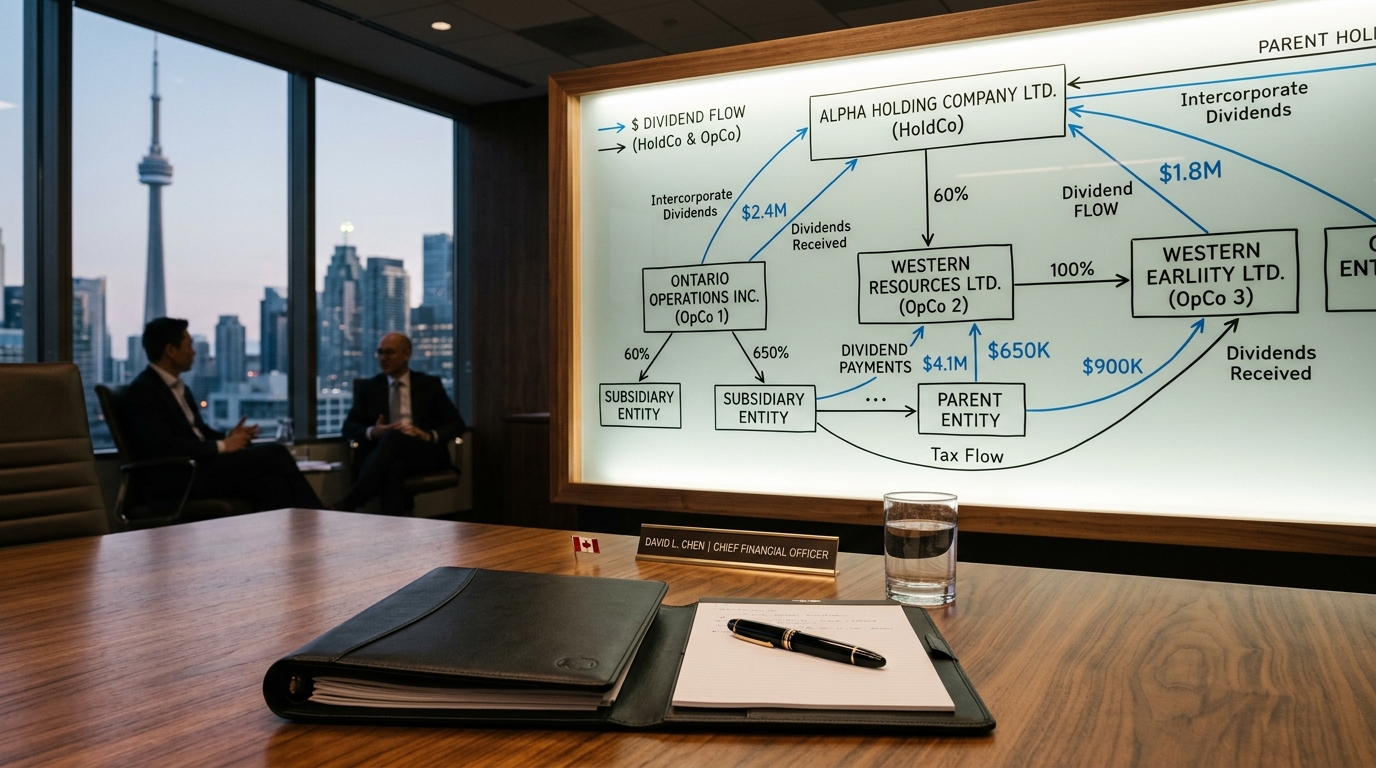
Among Canadian entrepreneurs, medical professionals, and business owners, setting up a corporate Holding Company (“HoldCo”) has long been marketed as the ultimate badge of financial sophistication. Wealth advisors and corporate lawyers frequently pitch a two-tier HoldCo-OpCo structure as an all-in-one solution for creditor protection, tax deferral, and estate planning. Yet under tightened Canada Revenue Agency scrutiny, mandatory UHT filings, Section 55(2) dividend penalties, and escalating accounting fees, a holding company can easily become a five-figure financial albatross that delivers near-zero tax savings while creating substantial administrative friction.
- The Annual Administrative Floor: Operating an active HoldCo incurs $3,500 to $7,500 annually in incremental accounting fees, T2 corporate tax return preparation, legal minute book updates, and corporate registry maintenance.
- The Passive Income Fallacy: A HoldCo does not shield retained earnings from the CRA’s $50,000 passive income grinder. Under Section 125(5.1), HoldCo and OpCo are “associated corporations,” meaning HoldCo’s investment returns directly erode OpCo’s Small Business Deduction.
- The True Strategic Justifications: A HoldCo is mathematically and legally justifiable only for three clear objectives: creditor asset insulation, OpCo “purification” to preserve the Lifetime Capital Gains Exemption (LCGE), and multi-partner equity flexibility.
The True Financial Cost of Operating a HoldCo-OpCo Structure
Before assessing the strategic utility of a holding company, owners must calculate the real, recurring friction of maintaining multiple corporate entities. A holding company is not a virtual file folder—it is a separate legal taxpayer requiring rigorous compliance.
| Expense Category | Initial Setup (Year 1) | Ongoing Annual Cost | Forensic Risk & Notes |
|---|---|---|---|
| Legal Incorporation & Restructuring | $3,500 – $8,000 | $0 | Articles of incorporation, share classes, corporate resolutions. |
| Section 85 Share Rollover & Legal Opinion | $4,000 – $12,000 | $0 | Required to roll OpCo shares into HoldCo on a tax-deferred basis without triggering immediate capital gains. |
| Annual T2 Corporate Tax Filing & Financials | $0 | $2,500 – $5,500 / yr | Separate financial statements, General Index of Financial Information (GIFI), and CRA T2 filing. |
| Annual Corporate Minute Book Maintenance | $0 | $600 – $1,200 / yr | Annual resolutions approving intercorporate dividends and director appointments. |
| Section 55(2) Safe Income Tracking | $0 | $1,000 – $3,000 / yr | CPA safe income on hand calculations required before declaring intercorporate dividends. |
| 10-Year Cumulative Cost | $7,500 – $20,000 | $41,000 – $97,000 | Total 10-Yr Friction: $48,500 to $117,000+ |
A business owner must ask: Does the holding company generate at least $6,000 to $10,000 in net annual financial value to offset its baseline maintenance cost? In many small-to-mid-sized operating practices, the answer is an unequivocal no.
The Myth of HoldCo Passive Income Shielding
One of the most persistent myths repeated in Canadian business forums is that transferring surplus cash from an operating company to a holding company isolates the cash from the CRA’s CCPC passive income tax trap. This is completely false.
Under Section 125(5.1) of the federal Income Tax Act, if an operating company and a holding company are owned or controlled by the same shareholder or related group of individuals, they are legally classified as associated corporations. The CRA aggregates the Adjusted Aggregate Investment Income (AAII) of both corporations into a single consolidated figure.
If your OpCo transfers $1,500,000 in surplus retained profits to HoldCo via tax-free intercorporate dividends, and HoldCo invests that capital in a portfolio producing $80,000 in taxable dividends, interest, and capital gains, that $80,000 triggers the exact same 5:1 clawback on OpCo’s Small Business Deduction limit. Creating a HoldCo does not provide a single dollar of passive income tax relief.
When a Canadian Holding Company Is 100% Worth It
Despite the administrative overhead and lack of passive income sheltering, a holding company remains an indispensable legal and corporate architecture tool in three specific commercial situations:
1. Creditor Insulation and Risk Segregation
If your operating company engages in commercial activities with inherent liability—such as commercial construction, manufacturing, medical surgery, retail leases, or employee litigation—leaving hundreds of thousands of dollars in retained cash inside OpCo is financial suicide. If a plaintiff successfully sues OpCo and wins a judgment exceeding your commercial general liability or malpractice coverage, every dollar in OpCo’s bank accounts, GICs, and investment portfolios can be seized.
By declaring a tax-free intercorporate dividend under Section 112(1) of the Income Tax Act, surplus cash is legally drained from OpCo and swept up to HoldCo. OpCo can even lease its heavy machinery or commercial real estate from HoldCo. Because HoldCo does not engage in customer-facing business operations, HoldCo’s balance sheet is completely insulated from OpCo’s operational creditors.
2. Purifying OpCo for the Lifetime Capital Gains Exemption (LCGE)
For entrepreneurs planning an eventual exit, the Canadian Lifetime Capital Gains Exemption (LCGE) allows individuals to shield over $1,250,000 in capital gains tax-free on the sale of Qualified Small Business Corporation (QSBC) shares. However, to qualify for the LCGE, your corporation must meet the CRA’s strict balance sheet tests:
- The 90% Test (At Disposition): At least 90% of the fair market value of OpCo’s assets must be used in an active business in Canada.
- The 24-Month Holding Test: Throughout the 24 months preceding the sale, more than 50% of the fair market value of the assets must have been used in active business.
If OpCo has accumulated $1,000,000 in cash and stocks on a business valued at $2,500,000, non-active passive assets represent 40% of the balance sheet. OpCo fails the 90% test, and the owner loses the multi-million-dollar LCGE shelter. A HoldCo solves this through OpCo purification: surplus non-active capital is systematically stripped out of OpCo via dividends into HoldCo, keeping OpCo’s balance sheet pristine and 100% compliant for an exit.
3. Implementing an Estate Freeze and Multi-Generation Wealth Transfer
When executing an estate freeze under Section 85, a holding company provides the vehicle to lock in the founder’s current accrued value into fixed-value preferred shares, while issuing new nominal-value common growth shares to a discretionary family trust or adult children. Future appreciation accrues outside the founder’s estate, capping terminal capital gains taxes at death while maintaining voting control via HoldCo voting shares.
The Section 55(2) Anti-Avoidance Trap: Safe Income on Hand
While Section 112(1) allows tax-free dividends between Canadian corporations, owners must be acutely aware of Section 55(2)—the CRA’s anti-stripping rule. The CRA prohibits corporations from paying intercorporate dividends if the primary purpose is to artificially reduce the fair market value of OpCo’s shares to avoid capital gains on a subsequent sale.
To pay tax-free intercorporate dividends safely, the dividend amount must not exceed OpCo’s Safe Income on Hand (SIOH)—the corporation’s after-tax retained active earnings that have already borne corporate income tax. If an aggressive accountant declares an intercorporate dividend exceeding SIOH, the CRA can recharacterize the entire tax-free dividend into a taxable capital gain, assessing retroactive penalties and interest.
Optimizing Retained Capital Inside HoldCo
For business owners who do maintain a HoldCo, managing the assets held within it requires sophisticated tax architecture. Rather than buying standard high-yield dividend funds or REITs that accelerate the passive income clawback, HoldCo surplus should be allocated into tax-sheltered structures:
- Corporate-Owned Life Insurance: Deploying excess HoldCo cash into COLI policies to grow wealth tax-sheltered and generate massive Capital Dividend Account credits upon maturity.
- Tax-Free Capital Dividend Extraction: Monitoring HoldCo’s balance sheet to promptly distribute balances from the Capital Dividend Account (CDA) to shareholders tax-free.
- Secured Intercompany Loans: Instead of leaving cash in HoldCo while OpCo borrows from commercial banks at 7%+ interest, HoldCo can lend capital back to OpCo under formal registered General Security Agreements (GSA), creating a secured senior creditor position.
Do not set up a holding company simply because someone told you it is “what successful business owners do.” If your operating company generates less than $150,000 in retained annual surplus after salaries, faces negligible commercial litigation risk, and has no planned third-party share sale within five years, a HoldCo is an unnecessary $5,000/year fee siphon. However, if your OpCo operates in a high-liability environment or you need to purify assets to capture the $1.25M+ Lifetime Capital Gains Exemption, a HoldCo is an essential corporate shield whose benefits dwarf the accounting overhead.
People Also Ask
Can money be transferred from an OpCo to a HoldCo without paying tax?
Yes. Under Section 112(1) of the Income Tax Act, dividends paid from a Canadian operating company to a connected Canadian holding company are generally received 100% tax-free, provided the dividend is backed by Safe Income on Hand and does not violate Section 55(2) anti-stripping provisions.
Does having a holding company reduce my personal income tax?
No. Transferring funds to a holding company defers tax at the corporate level, but as soon as money is extracted from either OpCo or HoldCo for personal use (via salary or personal dividends), standard personal income tax rates apply under Canadian tax integration rules.
What is a Section 85 rollover and why is it needed for a HoldCo?
A Section 85 rollover is an election under the Income Tax Act that allows a business owner to transfer appreciated shares of an operating company to a holding company in exchange for HoldCo shares without triggering an immediate deemed disposition and capital gains tax liability.