
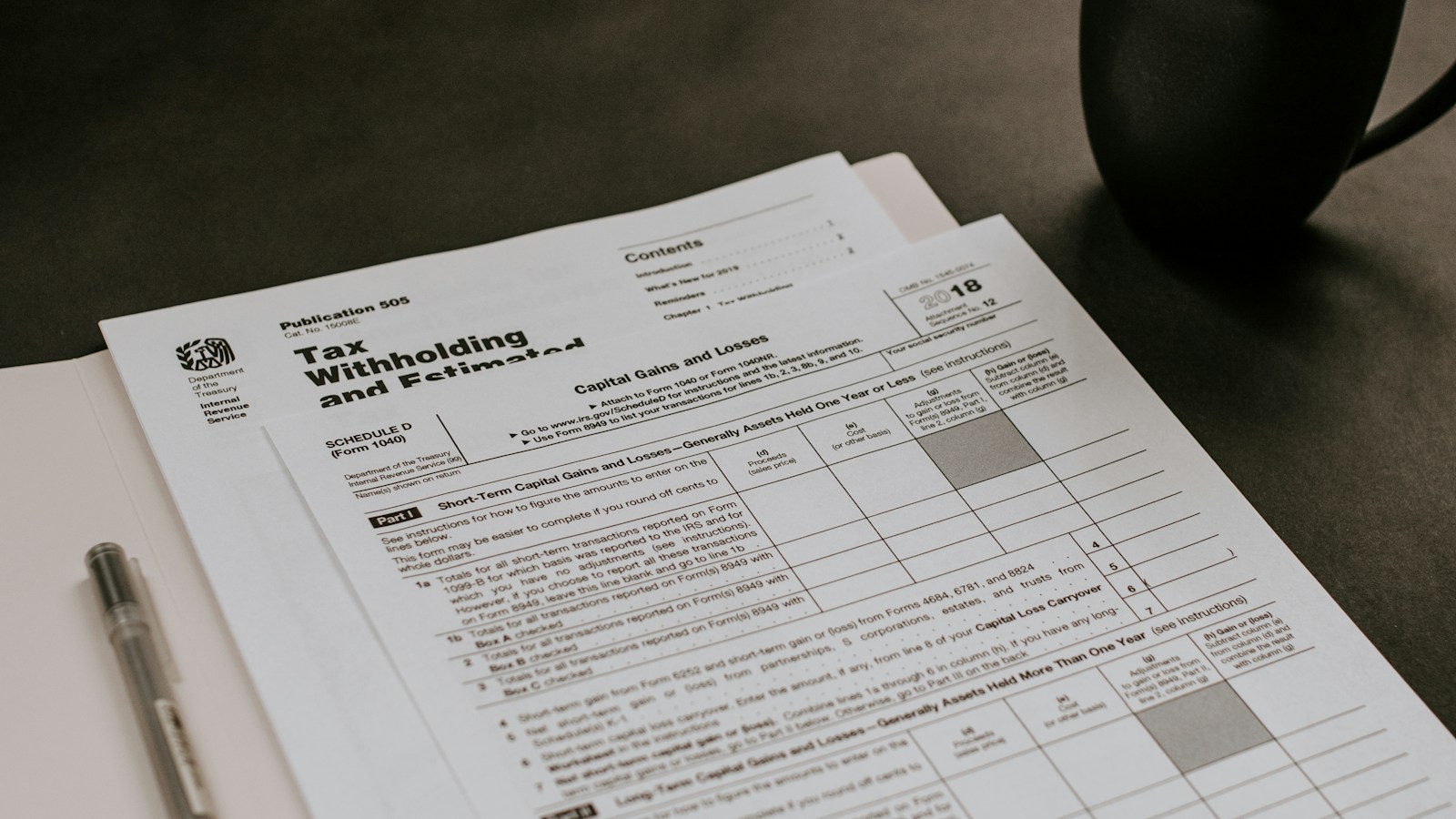
Under the Canada Revenue Agency’s aggressive corporate tax framework, incorporated professionals and business owners operating through a Canadian-Controlled Private Corporation (CCPC) face one of the most punitive fiscal tripwires in the Income Tax Act: the passive investment income clawback on the Small Business Deduction (SBD). Once your corporation’s Adjusted Aggregate Investment Income (AAII) crosses a modest $50,000 threshold, every single dollar of additional investment yield incinerates five dollars of active business income eligible for the ultra-low 9% federal small business rate.
- The 5:1 Grind Ratio: Between $50,000 and $150,000 of corporate passive income, your CCPC’s $500,000 Small Business Deduction limit is reduced by $5 for every $1 of investment income earned, reaching zero at exactly $150,000.
- The Phantom Tax Rate Spike: For corporations earning $500,000 in active operating profits, crossing from $50,000 to $150,000 in passive returns triggers a combined corporate tax increase of up to 14.3% on operating income (jumping from 12.2% to 26.5% in Ontario), siphoning up to $71,500 in excess tax annually.
- Asset Location & Reallocation Defense: Sheltering retained earnings via corporate class ETFs, funding an Individual Pension Plan (IPP), and leveraging corporate-owned life insurance neutralize the AAII grind before clawbacks trigger.
The Anatomy of the $50,000 AAII Clawback Threshold
Enacted under Section 125 of the federal Income Tax Act, the passive income rules were explicitly designed to neutralize the deferral advantage enjoyed by CCPCs retaining surplus cash. Historically, business owners left active profits taxed at preferential rates (e.g., 12.2% in Ontario, 11% in Alberta) inside their operating or holding companies, reinvesting in public equities or fixed income instruments to compound wealth pre-personal tax.
Today, the CRA calculates your corporation’s Adjusted Aggregate Investment Income (AAII) across all associated corporations. AAII includes:
- Taxable capital gains (net of allowable capital losses) earned on corporate investments.
- Net rental income from commercial and residential investment real estate.
- Portfolio dividends from non-connected corporations (portfolio equities).
- Interest and foreign investment income.
Crucially, AAII excludes capital gains realized on the disposition of active business assets and dividends received from connected operating corporations. However, when passive investment portfolios generate more than $50,000 in total AAII, the business limit reduction formula activates with mathematical precision:
At $50,000 of passive income, the reduction is $0, leaving the full $500,000 SBD limit intact. At $75,000 of passive income, the reduction is 5 × $25,000 = $125,000, dropping your eligible active business limit to $375,000. At $150,000 of AAII, 5 × $100,000 = $500,000, fully eliminating your small business deduction and subjecting all corporate profits to the general corporate tax rate.
Quantitative Breakdown: The SBD Grind and Real Tax Drag
To understand the severe financial penalty of this rule, consider an incorporated business or professional practice generating $500,000 in net active business income in Ontario:
| Corporate AAII (Passive Income) | SBD Limit Reduction | Remaining SBD Limit | Active Profits at SBD Rate (12.2%) | Active Profits at General Rate (26.5%) | Total Corporate Tax on Operations | Incremental Tax Drag |
|---|---|---|---|---|---|---|
| $0 – $50,000 | $0 | $500,000 | $500,000 | $0 | $61,000 | $0 (Baseline) |
| $75,000 | $125,000 | $375,000 | $375,000 | $125,000 | $78,875 | +$17,875 |
| $100,000 | $250,000 | $250,000 | $250,000 | $250,000 | $96,750 | +$35,750 |
| $125,000 | $375,000 | $125,000 | $125,000 | $375,000 | $114,625 | +$53,625 |
| $150,000+ | $500,000 | $0 | $0 | $500,000 | $132,500 | +$71,500 / year |
When you evaluate the marginal effective tax rate on that additional $100,000 of passive income, the reality is staggering. On top of paying the upfront passive corporate tax rate of ~50.17% (refundable in part via RDTOH upon dividend distribution), the business suffers a direct $71,500 cash loss on operating income. This means your passive portfolio yields are effectively taxed at an astronomical punitive rate exceeding 80% if unaddressed.
The Taxable Capital Gains Inclusion Rate Shock
The urgency of managing the passive income trap escalated drastically following the federal changes to the capital gains inclusion rate. For corporations, 100% of realized capital gains above the baseline inclusion rate of two-thirds (66.67%) are pulled into taxable income, with zero personal $250,000 grandfathered thresholds.
Because taxable capital gains directly increase AAII, rebalancing a corporate portfolio or executing unplanned asset sales can inadvertently trigger a catastrophic clawback. Realizing a $150,000 capital gain produces $100,000 in taxable capital gain, instantly thrusting the corporation into the AAII reduction zone even if the portfolio generated minimal dividends or interest that year. Business owners who fail to account for multi-year capital staging end up cannibalizing their operating company’s tax shield.
5 Forensic Corporate Defense Strategies to Defend Your SBD
1. Deploy Corporate Class Structure ETFs
Traditional exchange-traded funds and mutual funds distribute annual dividends, interest, and realized capital gains, every cent of which flows directly into AAII. In contrast, corporate class ETFs in Canada hold underlying assets inside a single multi-class mutual fund corporation. Corporate expenses and share redemptions are netted internally, virtually eliminating taxable annual distributions. By converting passive yield into pure, unrealized capital gains that compound indefinitely, business owners prevent annual investment income from ever breaching the $50,000 threshold.
2. Establish an Individual Pension Plan (IPP)
For incorporated business owners and executives over age 40 earning substantial T4 salary, establishing an Individual Pension Plan (IPP) transfers corporate surplus out of the CCPC into a dedicated defined benefit pension trust. The contributions made by the corporation are 100% tax-deductible against active business income. More importantly, assets held inside the IPP grow completely tax-sheltered, and investment returns inside the trust generate zero AAII, safeguarding the SBD limit while building high-guarantee retirement wealth.
3. Corporate-Owned Life Insurance (COLI) with CDA Accumulation
Cash surrender value accumulating within an exempt life insurance policy is legally exempt from annual taxation under Section 148 of the Income Tax Act. Retained earnings directed into a universal or whole life policy do not produce interest, dividends, or capital gains that register under AAII calculations. Upon the death of the insured shareholder, the proceeds—net of the policy’s adjusted cost basis—credit the corporation’s Capital Dividend Account (CDA), allowing heirs to extract millions of dollars in capital 100% tax-free.
4. Capital Dividend Extraction and Shareholder Loan Paydowns
If your corporation has accumulated an existing positive balance in its CDA from past capital gains dispositions or life insurance payouts, leave zero cash stranded. Filing CRA Form T2054 to execute a tax-free capital dividend removes capital from the corporate perimeter, reducing the principal investment pool that generates AAII. The extracted funds can be sheltered inside individual TFSAs and FHSAs, where investment growth is totally exempt from federal scrutiny.
5. Strategic Salary Bonus-Down and Registered Account Funding
Rather than accumulating surplus capital in a taxable holding company, corporate owners should model the trade-off of paying sufficient annual salary to maximize personal RRSP contribution limits ($32,490+ in 2026). Corporate deductions for salaries reduce net income, while the personal RRSP deduction shields investment earnings from both personal tax and the corporate passive income grinder.
Retaining passive wealth in an unshielded Canadian corporation without active tax engineering is a recipe for fiscal devastation. Once your corporate portfolio exceeds $1,000,000, even a conservative 5% yield breaches the $50,000 CRA threshold and begins grinding down your active business deduction. High-earning incorporated professionals must immediately conduct a forensic portfolio audit: transition taxable fixed income to IPPs, shift corporate equity holdings to corporate-class structures, and systematically harvest capital dividends to prevent surrendering $71,500 in operating profit every single year.
People Also Ask
Does rental income count towards the $50,000 corporate passive income limit?
Yes. Net rental income earned from real estate properties held within your CCPC or associated holding company is classified as specified investment business income and is fully included in your Adjusted Aggregate Investment Income (AAII) calculation, contributing directly to the Small Business Deduction grind.
Are capital gains calculated at 100% or 66.7% for the AAII threshold?
Only taxable capital gains are included in AAII. Under the current inclusion rules, 66.67% of realized capital gains on passive investments are taxable for corporations and therefore count towards the $50,000 threshold. The non-taxable 33.33% portion bypasses AAII and credits the Capital Dividend Account (CDA).
Does having an associated holding company protect against the passive income clawback?
No. Under Section 125(5.1) of the Income Tax Act, the CRA aggregates the AAII of all associated corporations. If your operating company (OpCo) pays tax-free intercorporate dividends to your holding company (HoldCo), and HoldCo earns passive investment returns, that passive income grinds down OpCo’s Small Business Deduction just as if it were earned directly inside OpCo.
To protect your corporate active earnings from CRA passive investment clawbacks, review our forensic masterclass on Canadian Real Assets & Farmland REITs in Holding Corporations (2026): Navigating Section 125 Passive Income Limits, Capital Cost Allowance (CCA) & Inflation Hedging.