
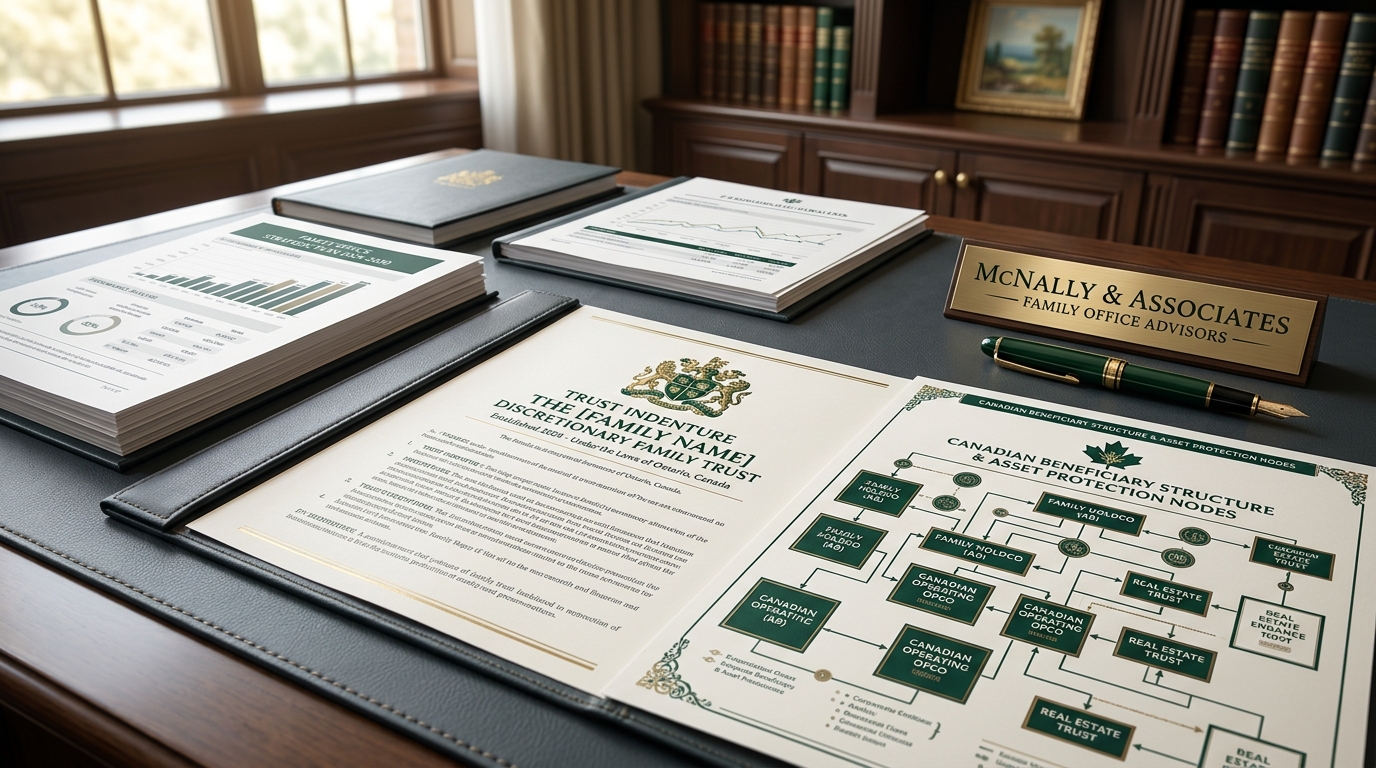
Under standard Canadian trust law, Subsection 107(2) of the Income Tax Act provides an invaluable benefit: property can be distributed out of a personal trust to a Canadian resident beneficiary on a tax-deferred “rollover” basis, rolling out at the trust’s adjusted cost base without triggering capital gains. However, lurking within the Income Tax Act is Subsection 107(4.1)—a severe anti-avoidance tripwire. If Subsection 75(2) (the revocable trust attribution rule) has ever applied to any property contributed to the trust, Subsection 107(4.1) automatically denies the tax-free rollover for all capital distributions to any beneficiary other than the original contributor. In 2026, as multi-generational family trusts approach their 21-year deemed realization dates, Subsection 107(4.1) represents a ticking tax time bomb.
Discretionary family trusts have long been the bedrock of private wealth structuring in Canada. Used in tandem with holding companies, estate freezes, and operating corporations, trusts allow founders to allocate future growth to children and grandchildren while retaining operational control. Yet, improper trust drafting or careless funding transactions can permanently taint the trust indenture, triggering unintended deemed dispositions.
Understanding trust attribution traps links directly to our strategic masterclasses on the family trust 21-year rule and Section 107 distributions and Canadian departure tax and non-resident deemed dispositions.
What Triggers the Subsection 107(4.1) Denial of Rollover?
Subsection 107(4.1) is triggered whenever property is distributed to a beneficiary from a trust where Subsection 75(2) previously applied to any contributor. When triggered, the trust cannot distribute capital assets on a tax-deferred basis under Subsection 107(2); instead, the distribution is deemed to occur at fair market value, triggering immediate capital gains tax.
The lethal nature of Subsection 107(4.1) lies in its “once tainted, always tainted” principle. If a founder contributed property to a trust under terms where the founder could reclaim the property, direct its distribution, or where the founder was the sole trustee with power to decide distributions to themselves, Subsection 75(2) is engaged. Once engaged, Subsection 107(4.1) permanently blocks tax-deferred rollovers to the founder’s children, grandchildren, or holding companies.
| Trust Rollover Scenario | Governing Section | Tax Consequence | Strategic Defense |
|---|---|---|---|
| Standard Distribution (Untainted) | Subsection 107(2) | Tax-deferred rollover at trust’s cost base (zero immediate tax) | Ensured settlor was an arm’s-length individual with no beneficial interest |
| Distribution from Tainted Trust | Subsection 107(4.1) | Rollover denied; deemed disposition at Fair Market Value | Must distribute assets exclusively back to the original contributor |
| Distribution to Non-Resident | Subsection 107(5) | Rollover denied; deemed disposition at FMV plus Part XIII withholding | Strip non-resident beneficiaries before distributing capital property |
Remedial Strategies: Curing or Navigating a 107(4.1) Trust Taint
If a forensic legal audit reveals that a family trust is tainted by Subsection 75(2), wealth advisors have three primary restructuring maneuvers:
- Roll Assets Back to the Contributor: Subsection 107(4.1) denies the rollover only for distributions to other beneficiaries. Rolling the corporate shares back to the original contributor (the founder) remains 100% tax-deferred under Subsection 107(2), after which a new, untainted estate freeze can be executed.
- Corporate Share Reorganization prior to 21 Years: Redeem preferred shares progressively over multiple tax years using safe income on hand, spreading the tax impact across multiple reporting periods.
- Utilize Non-Resident Beneficiary Purges: Amend the trust deed to explicitly exclude non-resident beneficiaries, eliminating simultaneous exposure to Subsection 107(5).
People Also Ask: Subsection 107(4.1) Attribution
Can a tainted trust be cured by replacing the trustees?
No. Replacing trustees or removing the contributor from the trustee board does not eliminate the historical application of Subsection 75(2). Once 75(2) has applied to a trust at any time during its existence, Subsection 107(4.1) permanently bars rollovers to non-contributor beneficiaries.
Does Subsection 107(4.1) apply to cash distributions?
No. Subsection 107(4.1) applies specifically to distributions of capital property (such as corporate shares or real estate) where a deemed capital gain can be realized. Distributing cash is not a transfer of property with an unrealized capital gain.
Why did the settlor give a silver coin to set up the trust?
In Canadian estate planning, trust deeds are intentionally settled using a nominal token (like a $20 silver coin) provided by a distant friend or arm’s-length accountant who has zero beneficial interest in the trust. This standard drafting convention is designed specifically to prevent the family founder from being deemed the settlor under Subsection 75(2).
A discretionary family trust is an exceptional wealth compounding vehicle, but it is unforgiving of technical drafting errors. The Subsection 107(4.1) attribution trap turns what should be a peaceful tax-free generational transfer into a forced liquidation event. Every family office and business owner approaching the 21-year trust deemed disposition must audit their historical settlement documents immediately to ensure their trust remains untainted.