
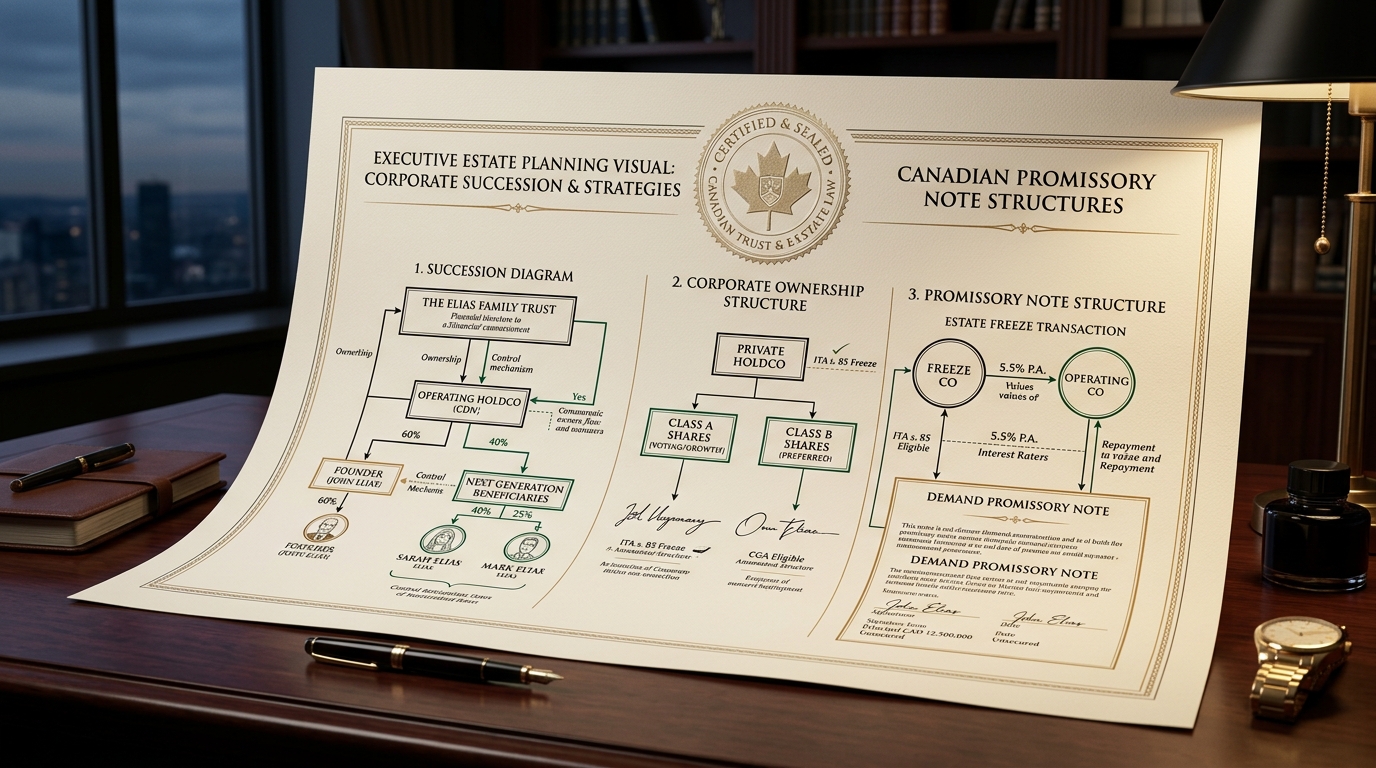
When an incorporated business owner dies in Canada, their estate faces an immediate and catastrophic threat: double (or even triple) taxation. Under Subsection 70(5) of the Income Tax Act, the deceased is deemed to have disposed of all corporate shares at fair market value immediately prior to death, generating capital gains tax up to 35.7%. If the estate subsequently extracts cash from the private corporation to distribute to beneficiaries, the withdrawal is treated as a taxable dividend, resulting in a combined effective tax rate that can exceed 70%. In 2026, Post-Mortem Pipeline Planning remains the premier legal architecture to eliminate double taxation by capitalizing the estate’s high adjusted cost base (ACB) into tax-free promissory note repayments.
Without sophisticated post-mortem planning, generations of accumulated wealth can be largely wiped out by uncoordinated tax liabilities upon the death of an owner-manager. While Subsection 164(6) loss carryback strategies offer relief within the first taxation year of a Graduated Rate Estate (GRE), pipeline transactions provide superior tax efficiency when corporate assets cannot be immediately liquidated.
This estate planning architecture integrates directly with our fiduciary blueprints for Section 85 estate freezes and corporate liquidity extraction via Capital Dividend Accounts.
How Does Double Taxation Occur on Death for Canadian Business Owners?
Double taxation occurs because Canadian tax law imposes capital gains tax on the deemed disposition of private corporate shares on the deceased’s terminal tax return, while simultaneously taxing the subsequent withdrawal of corporate assets by the estate as an ordinary or eligible dividend without automatic offsetting credit.
Consider an operating company worth $5,000,000 with a nominal share cost base of $100. On death, the terminal return reports a capital gain of approximately $5,000,000. The estate inherits the shares with a stepped-up Adjusted Cost Base (ACB) of $5,000,000. However, if the corporation simply winds up or pays a dividend to distribute the underlying cash, that distribution is taxed as a dividend. The estate is left with high-ACB shares that have no value, creating a capital loss that cannot be carried back past the estate’s first tax year without specific statutory relief.
| Post-Mortem Strategy | Execution Mechanics | CRA Compliance Window | Primary Limitation / Risk |
|---|---|---|---|
| Subsection 164(6) Loss Carryback | Redeem shares in Year 1 of estate; carry back resulting capital loss to terminal return | Strictly within first 12 months of estate inception (GRE status required) | Forces immediate corporate asset liquidation; dividend tax rates often exceed capital gains rate |
| Classic Pipeline Strategy | Transfer shares to new HoldCo for a promissory note; repay note tax-free from OpCo cash | Requires 1-year waiting period and continued corporate activity under CRA rulings | Must satisfy strict CRA administrative guidelines to prevent Section 84(2) dividend deemed recharacterization |
| Hybrid Pipeline & 164(6) | Combines capital dividend account extraction with partial pipeline debt repayment | Staggered across estate Year 1 and Year 2 | Complex legal drafting; requires advance tax ruling or seasoned tax counsel opinion |
The 5 Step Pipeline Blueprint: How to Extract Cash Tax-Free
To withstand CRA review under General Anti-Avoidance Rule (GAAR) provisions and Section 84(2), a pipeline must adhere strictly to CRA administrative ruling practices:
- Incorporate New HoldCo: The estate incorporates a new Canadian holding company (NewCo).
- Section 85 Share Transfer: The estate transfers its high-ACB shares of OpCo to NewCo in exchange for high-basis shares and a promissory note equal to the fair market value / ACB of OpCo.
- The Mandatory Waiting Period (1 Year): OpCo continues to operate its commercial business or hold investments for a minimum of one full year. Liquidating immediately violates CRA pipeline guidelines.
- Amalgamation or Wind-Up: After the waiting period, OpCo and NewCo are amalgamated under Section 87 or OpCo is wound up into NewCo under Subsection 88(1).
- Repayment of Promissory Note: NewCo uses corporate earnings and cash flow over an extended period (typically 12 to 24 months) to repay the promissory note to the estate completely tax-free as return of capital.
People Also Ask: Canadian Pipeline Planning
Does the CRA challenge pipeline transactions under GAAR?
The CRA has issued numerous Advance Income Tax Rulings approving pipeline transactions, confirming that Subsection 84(2) and GAAR will not apply, provided the estate observes the administrative guidelines: maintaining the corporation for at least one year and repaying the promissory note progressively over time.
What is the primary advantage of a pipeline over Subsection 164(6)?
The primary advantage is tax rate arbitrage: a pipeline preserves the lower capital gains tax paid on the terminal return (effective rate approx 26%–35%), whereas a Subsection 164(6) loss carryback converts the corporate distribution into a taxable dividend (effective rates up to 47%–49%), yielding substantially higher net inheritance for beneficiaries.
Can a pipeline be used for holding companies containing only cash and marketable securities?
Yes. The CRA permits pipeline planning for investment holding companies, provided the holding company continues to actively manage its investment portfolio during the mandatory waiting period before promissory notes are redeemed.
Double taxation upon death is the silent destroyer of Canadian private family wealth. By engineering a disciplined Post-Mortem Pipeline, an estate can convert stepped-up share basis into tax-free promissory note debt, saving beneficiaries hundreds of thousands or millions of dollars in unnecessary dividend taxes. When planning private corporate successions, never leave post-mortem mechanics to chance.