
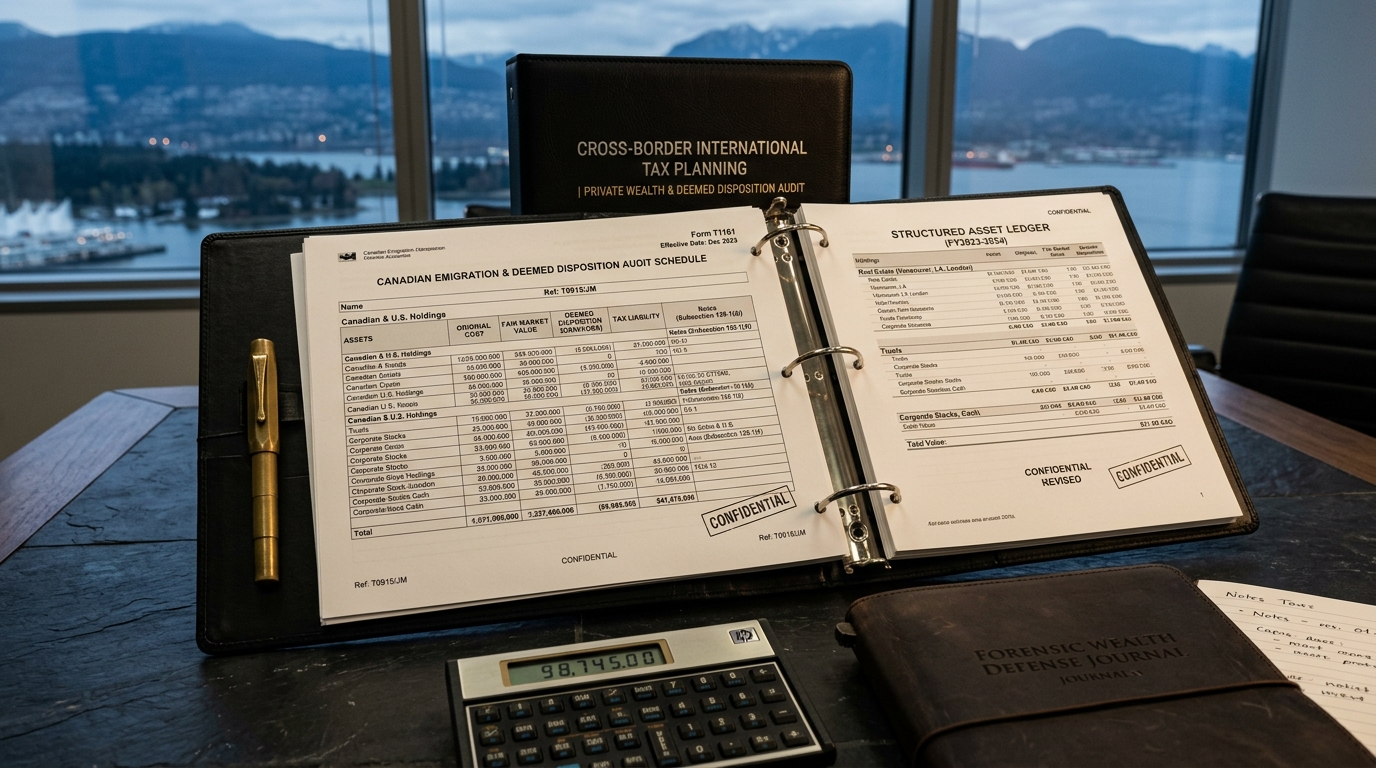
When high-net-worth professionals, tech founders, and retirees sever their Canadian tax residency to relocate abroad in 2026, the Canada Revenue Agency (CRA) enforces one of the most punitive exit tax regimes in the industrialized world: The Departure Tax (Section 128.1 of the Income Tax Act). The exact calendar day you cease to be a Canadian tax resident, the CRA deems that you have disposed of all worldwide capital property at Fair Market Value (FMV). This deemed disposition triggers immediate, phantom capital gains taxes on unrealized investments—even though you have not sold a single share or received a single dollar of liquidity.
- Deemed Disposition Scope: Departure tax applies to taxable non-registered equities, global ETFs, cryptocurrency, private Canadian corporation shares (HoldCos/OpCos), and international real estate. It does not apply to Canadian real property, registered accounts (RRSP, RRIF, TFSA), or pension entitlements.
- Mandatory Reporting ($25,000 Threshold): If the aggregate fair market value of your reportable worldwide assets exceeds $25,000 upon departure, you are legally required to file CRA Form T1161 and Form T1243 with your final emigrant tax return. Failing to file triggers severe penalties of $25 per day up to $2,500 per form.
- The Section 220(4.5) Deferral Election: Emigrants can legally defer payment of the departure tax until the assets are actually sold by filing Form T1244 and posting acceptable security (such as a bank letter of credit) with the CRA for tax liabilities exceeding $16,500 ($14,500 in Quebec).
CRA Deemed Disposition Matrix: Taxable vs. Exempt Assets (2026)
Auditing the tax treatment of your balance sheet prior to departure is essential to prevent unexpected, six-figure tax liabilities:
| Asset Classification | Subject to Deemed Disposition? | Mandatory Form T1161 Reporting? | Post-Departure Tax Exposure |
|---|---|---|---|
| Taxable Stocks & Global ETFs | Yes (Deemed Sold at FMV) | Yes (If total assets > $25k) | ACB stepped up to FMV on departure date |
| Private Canadian Corp Shares (HoldCo) | Yes (Deemed Sold at FMV) | Yes | High risk: triggers huge phantom capital gains |
| Canadian Real Estate (Rental / Primary) | No (Explicitly Exempt) | No (Exempt from T1161) | Taxed upon eventual physical sale (Section 216/116) |
| Foreign Real Property (US Vacation Home) | Yes (Deemed Sold at FMV) | Yes | Capital gain calculated in CAD at departure exchange rate |
| RRSP / RRIF Registered Accounts | No (Exempt from Deemed Sale) | No | Subject to 25% (or 15% treaty) Part XIII withholding on withdrawal |
| TFSA & FHSA Accounts | No (Exempt from Deemed Sale) | No | Can remain open, but new contributions incur 1%/month penalty |
| Cryptocurrency Holdings | Yes (Deemed Sold at FMV) | Yes | Tracked at fair market value in CAD on exit date |
Form T1161 and Form T1243: The Compliance Tightrope
When you cease Canadian tax residency, your final T1 Individual Tax Return requires two specific disclosure schedules:
- Form T1161 (List of Properties Owned by an Emigrant): A comprehensive census of your worldwide assets on the date of departure. If the fair market value of all reportable assets exceeds $25,000, you must list every asset, its cost, and market value. Personal effects (clothing, furniture, vehicles) with an individual value under $10,000 are excluded.
- Form T1243 (Deemed Disposition of Property by an Emigrant): The tax computation schedule where each deemed disposition is calculated. The Adjusted Cost Base (ACB) is subtracted from the departure-date FMV. The resulting taxable capital gain flows directly to Schedule 3 of your T1 return, subjected to standard Canadian capital gains inclusion rates.
For investors managing non-registered accounts, applying strategic tax-loss offsets prior to exit can neutralize substantial departure tax liabilities; review our guide on Tax-Loss Harvesting in Canada & Superficial Loss Defense.
Deferring Payment: The Section 220(4.5) Election & Form T1244
Few individuals have the liquid capital to pay taxes on millions in unrealized gains upon moving abroad. To prevent capital destruction, the Canadian tax system provides a formal relief valve under Subsection 220(4.5) of the Income Tax Act:
# Section 220(4.5) Deferral Execution (Form T1244)
1. File Form T1244 concurrently with your final emigrant T1 return.
2. If federal departure tax liability is <= $16,500 ($14,500 for Quebec):
   -> Deferral is granted AUTOMATICALLY with ZERO security required.
3. If federal departure tax liability exceeds $16,500:
   -> You MUST negotiate and pledge acceptable security with CRA:
      - Bank Letter of Credit or Guarantee from a Canadian Schedule I bank
      - Real estate mortgage or registered charge on Canadian property
      - Share certificates of private Canadian corporations (negotiable)
4. No interest accrues on the deferred tax balance while security is held.
5. Tax becomes payable only when the asset is physically sold.
The Private Holding Company Trap: Severe Double-Tax Hazards
For incorporated Canadian business owners and medical professionals holding private Holding Companies (HoldCos), departing Canada without pre-exit corporate restructuring is disastrous. To understand the operational and tax structure of these entities, examine our diagnostic on Is a Canadian Holding Company Worth the Cost in 2026?.
When you emigrate holding shares of a Canadian HoldCo:
- Immediate Phantom Capital Gain: Your HoldCo shares are deemed disposed of at Fair Market Value, triggering immediate departure tax on all accumulated retained earnings.
- Corporate Residency Complications: If you are the sole director and manage the HoldCo from abroad, the CRA or your new home country may deem the corporation a tax resident of your new jurisdiction under the “Central Management and Control” test, subjecting the corporate entity to double corporate tax.
- Pre-Exit Capital Dividend Extraction: Business owners must clear out the corporation’s Capital Dividend Account (CDA) and refundable tax pools prior to severing residency, pulling tax-free capital out before non-resident withholding rules lock in.
Post-Departure Cash Flows: Navigating Part XIII Withholding Tax
Once you are officially a non-resident, Canada ceases taxing your worldwide income. However, any income generated from Canadian sources is subject to Part XIII Non-Resident Withholding Tax:
- Standard Statutory Rate: 25% flat withholding deducted at source by Canadian financial institutions on all RRSP/RRIF withdrawals, Canadian corporate dividends, and rental revenues.
- Tax Treaty Reductions: If you relocate to a jurisdiction with a bilateral Canadian Tax Treaty (e.g., the United States, the UK, Australia), withholding rates on periodic pension payments and dividends are frequently reduced to 15%.
- Section 216 Election for Rental Property: If you retain Canadian real estate, filing a Section 216 election allows you to pay tax on net rental income (after mortgage interest, property taxes, and maintenance deductions) rather than paying a brutal 25% withholding tax on gross rental income.
If you are relocating to the United States or hold US dual citizenship, pair this exit architecture with our cross-border tax analysis in US Citizens Living in Canada: TFSA & PFIC Defense.
Alistair Vance’s Verdict
Severing Canadian tax residency is not a matter of packing a suitcase and handing in your provincial health card. It is a formal, statutory liquidation event under the eyes of the Canada Revenue Agency. Leaving without rigorous advance planning invites punitive audit reassessments and unnecessary cash liquidation of investment portfolios.
Begin planning your departure at least one year before crossing the border. Harvest embedded capital losses to offset deemed gains, drain your HoldCo’s Capital Dividend Account, evaluate the Section 220(4.5) security deferral election, and ensure Forms T1161 and T1243 are executed with surgical accuracy. In cross-border wealth defense, proper documentation is the only moat that stands between your balance sheet and the CRA.
Where to Expand Your Cross-Border Tax Architecture Next
Continue fortifying your corporate structures, residency defense, and cross-border accounts with our specialized investigations:
- Canadian Holding Company Audits: Evaluate whether to wind up or maintain your HoldCo in our Holding Company Cost & Section 85 Guide.
- Tax-Loss Harvesting Defense: Neutralize capital gains liabilities using The Canadian Tax-Loss Harvesting Playbook.
- US-Canada Cross-Border Traps: Protect registered investments from IRS penalties in our US Citizens in Canada TFSA & PFIC Audit.
People Also Ask
What triggers the Canadian departure tax?
Departure tax is triggered under Section 128.1 of the Income Tax Act on the exact date an individual ceases to be a factual or deemed resident of Canada for tax purposes. The CRA deems that you have disposed of all worldwide capital property (with specific exemptions like Canadian real estate and registered pensions) at fair market value immediately before departure.
Are RRSPs and TFSAs subject to departure tax when leaving Canada?
No. Registered accounts including RRSPs, RRIFs, TFSAs, FHSAs, and RESPs are explicitly excluded from the deemed disposition rules under departure tax. However, once you become a non-resident, subsequent contributions to a TFSA incur a 1% per month penalty, and withdrawals from RRSPs/RRIFs are subject to a 25% non-resident withholding tax (often reduced to 15% under tax treaties).
Can I defer paying the Canadian departure tax?
Yes. Under Subsection 220(4.5) of the Income Tax Act, emigrants can elect to defer payment of departure tax until the assets are actually sold by filing Form T1244. If the federal tax amount exceeds $16,500 ($14,500 in Quebec), acceptable security (such as a bank letter of credit) must be pledged with the CRA.
What is CRA Form T1161 and who must file it?
Form T1161 is a mandatory information return listing all properties owned by an emigrant on the date of departure. Any individual severing Canadian tax residency whose total reportable worldwide property exceeds $25,000 in fair market value must file Form T1161. Late filing carries a penalty of $25 per day, up to a maximum of $2,500.