
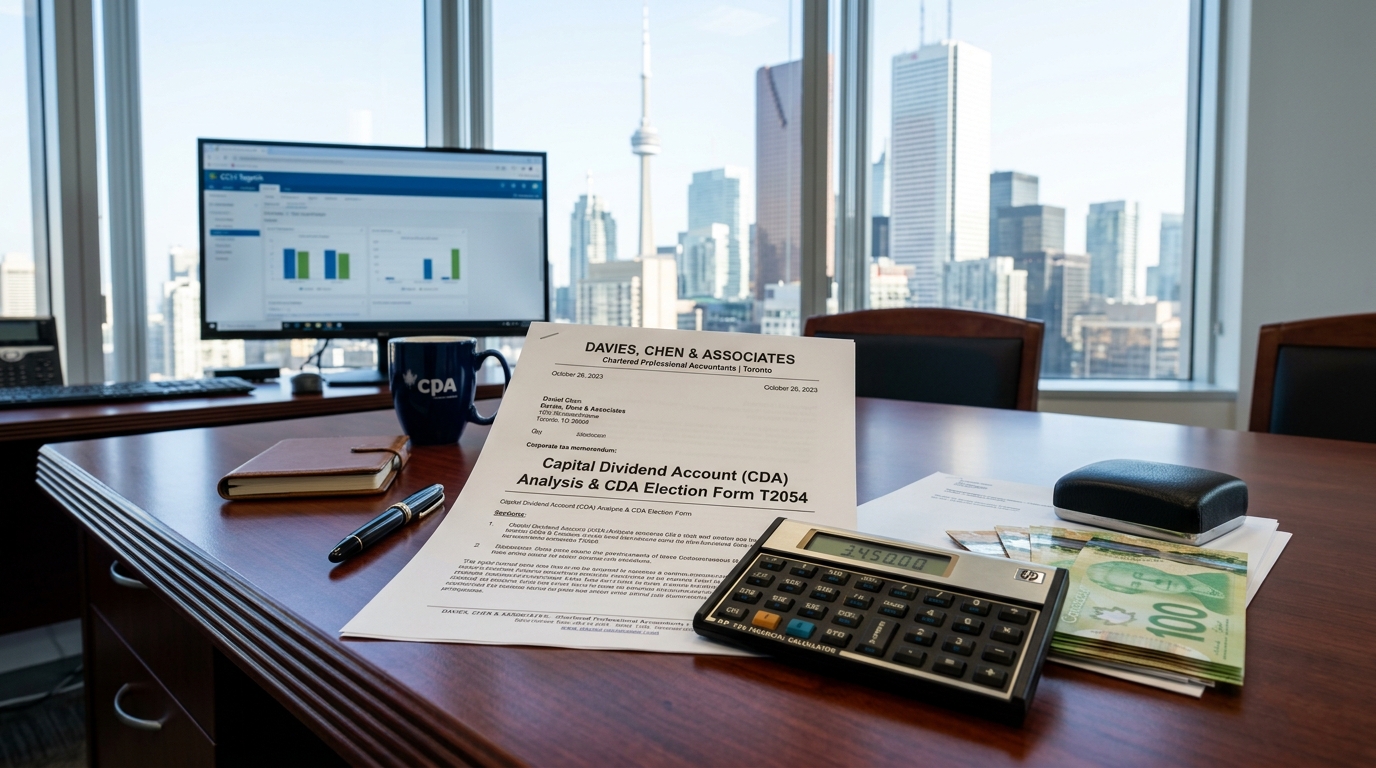
For Canadian incorporated business owners and holding company directors, extracting retained earnings typically triggers punishing marginal dividend tax rates exceeding 47% on ineligible dividends and 39% on eligible dividends. However, buried within the Canadian Income Tax Act sits one of the most powerful wealth-extraction mechanisms in the modern financial world: the Capital Dividend Account (CDA). When properly tracked and formally elected, a corporation’s CDA balance allows shareholders to extract millions of dollars in corporate surplus completely 100% tax-free.
Under Section 89(1) of the Income Tax Act, the Capital Dividend Account is a cumulative, non-accounting tax ledger that records non-taxable corporate receipts, primarily the non-taxable 50% portion of realized capital gains and corporate-owned life insurance death benefits net of adjusted cost basis (ACB). To extract these funds tax-free, the corporation must formally file CRA Form T2054 with certified directors’ resolutions prior to dividend disbursement. Electing even $1 in excess of the verified CDA balance triggers a punitive 60% Part III excess dividend tax penalty.
What Is the Capital Dividend Account (CDA) in Canada?
The Capital Dividend Account (CDA) is a special corporate tax account governed by Section 89(1) of the Income Tax Act that tracks tax-free amounts accumulated by a Canadian Controlled Private Corporation (CCPC). When a corporation pays a capital dividend out of its CDA balance, Canadian resident shareholders receive the funds completely free of personal income tax.
The core policy intent behind the CDA is integration: ensuring that capital gains realized through a private corporation bear the exact same aggregate tax burden as capital gains realized directly by an individual. Because individuals are taxed on only 50% of capital gains (subject to recent alternative AMT and inclusion thresholds), the remaining non-taxable 50% realized by a corporation is credited directly to the CDA pool, ready to be passed on to shareholders without additional taxation.
The Four Inflow Streams That Build Your CDA Balance
A corporation’s CDA balance is fed by four distinct statutory balance-sheet events:
| CDA Inflow Component | Statutory Formula / Source | Strategic Wealth Impact |
|---|---|---|
| Non-Taxable Capital Gains | 50% of realized capital gains minus non-allowable capital losses | Direct tax-free dividend pool created from stock or real estate sales. |
| Life Insurance Death Benefit | Net insurance proceeds minus policy Adjusted Cost Basis (ACB) | Enables multi-million-dollar tax-free succession liquidity for surviving heirs. |
| Capital Dividends Received | 100% of capital dividends received from another CCPC / OpCo | Allows tax-free flow-through of CDA funds up holding company chains. |
| Eligible Capital Property | Cumulative net gain from goodwill and commercial intangible sales | Tax-free extraction during corporate business asset sales. |
For related corporate restructuring strategies, review our forensic guides on Subsection 55(2) Safe Income on Hand (SIOH) in Canada (2026) and CRA Section 160 Derivative Assessments in 2026.
The Capital Loss Trap: Why Timing Is Everything
One of the most dangerous and expensive mistakes business owners make is failing to harvest CDA balances before realizing capital losses. The CDA is a cumulative running ledger. If your operating or holding company realizes a $500,000 capital gain, your CDA immediately increases by $250,000. If you pay that $250,000 capital dividend out today, it is received 100% tax-free.
However, if the corporation retains the balance and subsequently incurs a $300,000 capital loss on another investment, the non-allowable 50% loss ($150,000) is automatically subtracted from your CDA balance, reducing your available tax-free extraction room to just $100,000. Golden Rule: Always elect and distribute capital dividends immediately after realizing substantial capital gains before future unrealized losses can erode your CDA room.
Filing CRA Form T2054 & The 60% Part III Tax Penalty
Unlike regular taxable dividends, you cannot simply declare a capital dividend on an annual T5 slip. Under Section 83(2) of the Act, the corporation must formally execute an election using CRA Form T2054: Election for a Capital Dividend Under Subsection 83(2).
- Mandatory Filing Deadlines: Form T2054 must be filed on or before the earlier of the day the dividend becomes payable or the day any part of the dividend is paid. Late filings incur late penalties of $41.67 per month.
- Certified Directors’ Resolution: The filing must include a certified copy of the directors’ resolution authorizing the exact dividend amount and specifying the dividend becomes payable on that date.
- The 60% Excess Election Trap: If the corporation elects a dividend of $200,000 when the verified CDA balance was only $180,000, the $20,000 excess triggers an immediate 60% Part III penalty tax ($12,000) under Section 184(2), unless all shareholders agree to make a corrective Subsection 184(3) election to reclassify the excess as a regular taxable dividend.
The Capital Dividend Account is the holy grail of Canadian private corporate wealth planning. Never leave CDA balances sitting idle inside holding companies where subsequent capital downturns can permanently erase your tax-free extraction room. Always request an official CRA CDA Verification Schedule before executing Form T2054 to ensure zero Part III penalty exposure.
People Also Ask (PAA)
Are capital dividends taxable on personal Canadian income tax returns?
No. Capital dividends paid out of a verified Capital Dividend Account are received 100% tax-free by Canadian resident shareholders and are not reported as taxable income on personal T1 returns.
Can a non-resident shareholder receive capital dividends tax-free?
No. Capital dividends paid to non-resident shareholders are subject to Canadian non-resident withholding tax (typically 25%, or 15% under tax treaties).
How do I check my corporation’s official CDA balance with the CRA?
Your corporate accountant can file a formal request for a CDA balance verification with the CRA, or inspect your corporate tax account details through CRA My Business Account.